Meme coin trading can turn a four-figure bankroll into seven figures if you treat the trenches like a full-time job
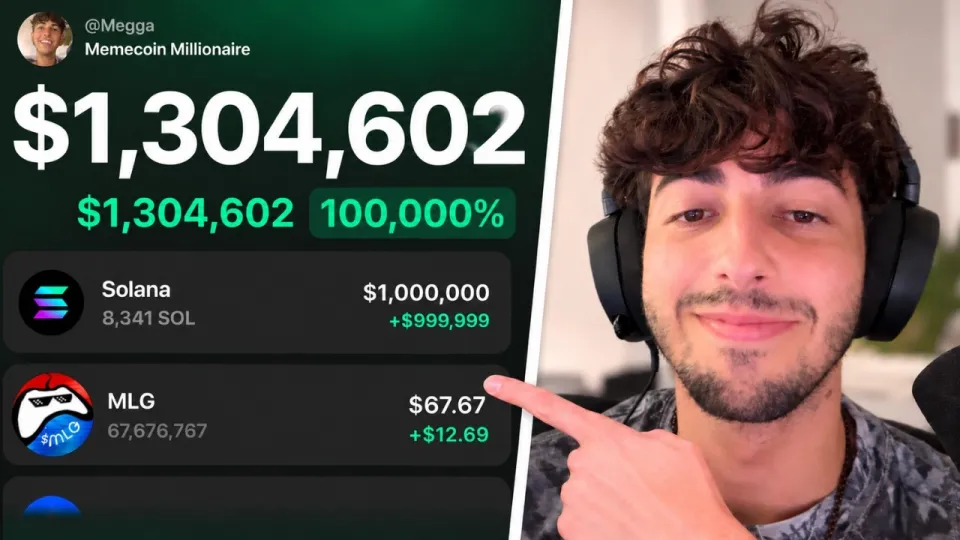
Video: How I Made $1,000,000 Trading Memecoins (FULL BREAKDOWN)
Want articles like this for your own video to promote it on YouTube and Google? Order them through the Telegram bot @sat_sit_bot. The bot writes and publishes the articles itself (with your YouTube video embedded) on popular topical websites (no ads). Free trial — 50 articles.
· based on the channel Megga
Key takeaways
- Megga's breakdown covers a $1,000,000 PnL built on meme coin trading, not on a single lucky token.
- The routine described is 9–12 hours a day in the trenches: screening, executing, reviewing.
- Free course and a low-fee trading terminal are the two links promoted with the video.
- Most viewer pushback is about liquidity: every dollar of profit comes from another trader's loss.
- Surviving drawdowns and phishing wallet drains is treated as part of the process, not an exception.
Meme coin trading is the practice of buying and selling newly launched tokens with no fundamentals, where profit comes almost entirely from timing, liquidity and risk control rather than from any product or cash flow. The breakdown published by Megga, a Fortnite pro turned trader, frames a $1,000,000 PnL as the output of a repeatable routine in the trenches rather than a single lucky trade. Anyone who wants the same starting point can grab the free trading course that ships with the video.
What a meme coin actually is and why the returns look so extreme
A meme coin is a token whose price is driven by attention and community rather than revenue, which is exactly why it can multiply in hours and go to zero in minutes. Supply is usually concentrated in a handful of wallets at launch, liquidity sits in a thin pool, and there is no earnings report to anchor a valuation. That structure produces two things: enormous percentage moves and a market where the exit is always narrower than the entry. Understanding this asymmetry is the first step before any chart or scanner matters, because the same mechanic that pays a 200x also wipes out a wallet that hesitated for thirty seconds.
The trading stack: wallet, terminal and the fee math
The tools are simple, but the order you set them up in determines whether you keep your capital. A typical setup looks like this:
- A dedicated hot wallet with only trading capital in it, never linked to long-term holdings.
- A second, clean wallet used purely as a vault, funded only by withdrawals.
- A trading terminal connected to the wallet, chosen for execution speed and low fees — the one promoted alongside the video is Padre.
- A block explorer and a scanner for contract checks, holder distribution and liquidity locks.
- A written log of every entry, exit and reason, kept outside the browser.
Fees matter more than beginners expect: on a fast in-and-out strategy, a few tenths of a percent per side compounds into a serious drag across hundreds of trades, which is why low-fee routing is treated as infrastructure rather than a nice-to-have.
How the 9-to-12-hour routine is actually structured
The hours are the strategy; the trades are just the output. A workday in the trenches breaks into four blocks: pre-market scanning for fresh launches and narratives, active execution during the highest-volume window, a review pass over every closed position, and a research block for reading on-chain data and following the accounts that consistently surface early flow. Viewers often ask what fills those hours, and the honest answer is that most of it is filtering — rejecting dozens of setups to take two or three, then writing down why the rejected ones were rejected. Consistency in the routine is what makes the PnL curve look stable on a chart even when individual days are red.
Position sizing and risk rules that keep a seven-figure PnL alive
Risk control is the only part of meme coin trading that compounds reliably. Practical rules that fit this style of trading:
- Size every position as a fixed small percentage of the bankroll, so a total loss never changes the plan.
- Take the initial capital out at the first meaningful multiple and let the rest run as a free bet.
- Cap the number of open positions so you can actually watch all of them.
- Pre-commit exit levels before entry, because in a fast candle the decision is already made.
- Keep a hard daily loss limit and stop when it is hit, regardless of how good the next setup looks.
- Never approve unlimited token allowances and never sign a contract you have not checked.
A 200x on a single token means nothing if a phishing signature drains the wallet the next week, and that is a scenario real traders in this niche describe openly.
Reading the meta: how to judge whether a narrative has legs
The meta is the story the market is currently paying for, and judging it early is a research skill, not intuition. Compare a new launch against the tokens that already ran in the same category: how fast did liquidity arrive, how concentrated are the top holders, is there a product or just a ticker, and does the community produce content or only price talk. Entering before roughly $30,000 in liquidity is where the asymmetry lives, but it is also where most rugs happen, so contract checks and holder distribution come before any conviction about the story. Treat a narrative that has already produced three runners as crowded, and treat a fresh one with real builders as the higher-expectancy bet.
The questions traders actually ask before starting
Most of the doubts around meme coin trading are not about charts. They are about time, capital and psychology. People with a job want to know whether a few hours a week can work — it can, but only with slower setups and smaller size, because the fast trenches reward presence. People with modest PnL want to know when they are ready to trade alongside others; a reasonable threshold is a documented track record over several months plus a strategy you can explain in one sentence. And the loudest critique, that profit has to come from someone else's loss, is simply true: this is a zero-sum liquidity game, and pretending otherwise is how beginners become the exit liquidity. The traders who last are the ones who treat losses as tuition, keep showing up, and separate self-worth from the daily number.
Useful links
Final takeaway
A seven-figure result in meme coins comes from a boring loop repeated at volume: screen, size small, cut fast, log everything, repeat tomorrow. The tools are cheap and the information is public, so the edge sits in routine, risk discipline and the willingness to sit through drawdowns without changing the plan. Megga's breakdown is useful precisely because it presents the grind rather than a highlight reel, and the free course is the natural next step if you want the same framework. Treat the numbers as an outcome of process, not a promise, and size every trade as if the next one could be the loss that ends the account.
Source: How I Made $1,000,000 Trading Memecoins (FULL BREAKDOWN) · Markdown version
Questions & answers
How much capital do you need to start trading meme coins seriously?
There is no fixed minimum, but the strategy has to match the bankroll: with a small account, position sizes shrink to the point where fees and slippage eat most of the edge. A practical approach is to start with an amount you can lose entirely without changing your life, prove the process over a few months, and only then scale. Trading alongside more experienced people makes sense once you have a documented track record rather than a single good week.
How do you tell whether a new narrative or meta will actually run?
Check whether the story is producing real activity: liquidity arriving quickly, holders spreading out instead of concentrating, and a community making content rather than only posting prices. Compare it with tokens that already ran in the same category and ask what is different this time. Entering very early, before liquidity reaches tens of thousands of dollars, offers the best asymmetry but also the highest rug risk, so contract and holder checks come first.
Is meme coin trading just taking money from other people?
In a market with no cash flows, every dollar of profit is another participant's loss, so yes — it is a zero-sum liquidity game. That does not make it illegitimate, but it does mean the person buying your exit is real, and the failure mode is being that person. Treating it as a competitive skill with strict risk limits is more honest than pretending the gains appear from nowhere.
What does a full day of trading actually consist of?
Most of the time goes to filtering and reviewing rather than clicking buy: scanning fresh launches, checking contracts and holder distribution, executing during the highest-volume window, then logging every closed position. Long sessions only pay off if the hours are structured, so a written routine with a fixed daily loss limit matters more than raw screen time. Without a review loop, ten hours a day is just expensive entertainment.